Tuesday, June 8, 2021

Friday, June 4, 2021
Islam and the Holy Grail
Something really significant that people don't often consider with Muhammad, is that; given how the Arab pagans used to bury their female infants alive because they viewed daughters as curses. How significant is it that Muhammad's only progeny surviving past childhood was Lady Fatimah. And how through Fatimah (who married Imam Ali obvs) that Muhammad's successorship was advanced.
Also, though you may know (I think I've mentioned it before) but Surah Kawthar is a promise God gave to Muhammad before the birth of Fatimah. The word Kawthar means "abundance" but it also, in Hadith, is metaphysically referred to as "the fountain in Paradise". From there it is obvious where Cup/Chalice symbolism in Qur'anic verses about Paradise factor into this.
The layers of symbols associated with Fatimah is profound. The whole "holy grail" myth in the middle ages comes out of Shi'ite tradition, relating to Fatimah and Ali, but as it was appropriated into the Parzival story (which Crowley and other occultists of his day very much loved) where Christianized to be about Jesus rather than Muhammad.
However of course the "holy grail" is also connected to Alchemy/Hermeticism as well, with the concept of Magnum Opus or "the Great Work".
One further interesting connection there is between Fatimah's Sophic aspect and the Babalon of Thelema, to which Crowley attributes the Grail symbology in texts like Liber Cheth and Liber 418.
This is all part of a grand mystery nonetheless. It is really upsetting that so many western esotericists/occultists want to exclude and bastardize Islam from this conversation when it undoubtedly contains all the missing pieces. The answers of western occultism are to be found where the biggoted minds of so many westerns don’t want to look: Islam, but not just that but Shia Islam (the seed where Sufism sprouted too).
Tuesday, June 1, 2021
Christianity's forgotten mystery
On the evening of that day, the first day of the week, the doors being shut where the disciples were, for fear of the Jews, Jesus came and stood among them and said to them, “Peace be with you.” When he had said this, he showed them his hands and his side. Then the disciples were glad when they saw the Lord.
Jesus said to them again, “Peace be with you. As the Father has sent me, even so I send you.”
And when he had said this, he breathed on them, and said to them, “Receive the Holy Spirit.
If you forgive the sins of any, they are forgiven; if you retain the sins of any, they are retained.”
(John 20:20-23)
Tuesday, May 25, 2021
The Baha'i New World Order
I find it funny that conspiracy theorists (or similar) haven't jumped at this yet:
(I'm not entirely sure but Baha'i's might have actually coined that term, which later emerged curing the Cold War era)
I've very rarely see it ever brought up.
The Baha'i "New World Order" and it's future legislative court, the "Universal House of Justice" (the group of old senile men staring at a wall), have an interesting kind of relation to both the Sunni Caliphate idea and the Catholic Papacy idea. Baha'i's have basically created a mishmash of both ideas, but leaning towards the Catholic idea in terms of religious authority but leaning towards the Sunni Caliphate in terms of how it will comprise unified territory across countries (aiming for the entire world, like both prior systems hoped to achieve but didn't).
In terms of Baha'i strategy they both play the Jewish/Christian card of 'pity us, we're persecuted' (which was a historical reality for Shia Muslims and Bayanis/Babis but we didn't make that historical reality the pillar of our faith) and try to nudge their way into the United Nations and European Union area of politics, as both provide good room for expansionism when things start to go to turmoil.
From Kitab Aqdas (also appearing as chapter 70 of Gleanings From the Writings of Baha'u'llah):
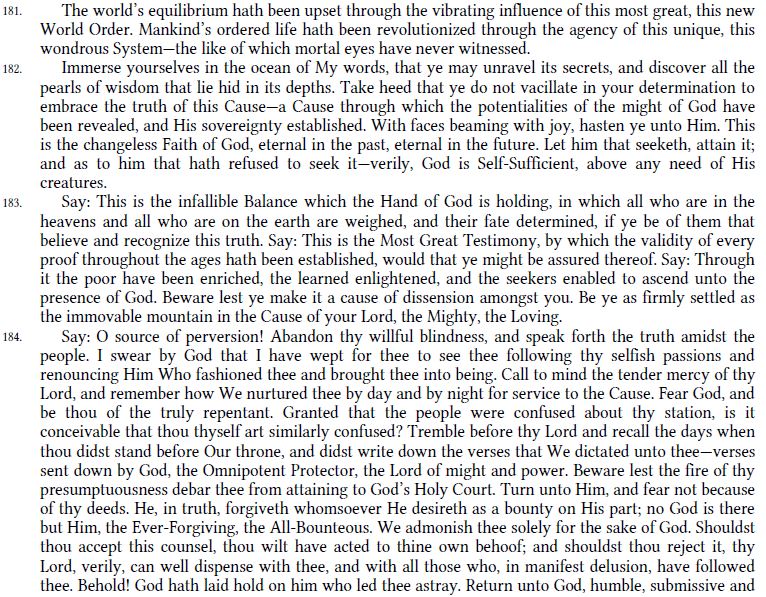
Tuesday, May 18, 2021
Between Quranism and more traditional forms of Islam: Authority and Hermeneutics
Between Quranism and more traditional forms of Islam (Sunni, Shia, Ibadi etc), there is the tension between the transhistory and hierohistory latent in the Qur'an very basic structure, discourse, doctrines and themes, and the actual historical context that chapters and verses are revealed it.
The Qur'an, as a transhistorical, hierohistorical, divine, sacred scripture of the speech of God, it is itself a talismanic unveiling within any point in history, as it points to the metaphysical nucleus which embodies any point in time, it is universal.
However the reception of the Qur'an itself and the Prophet who received it, is himself a part of this transhistory, this hierohistory in the same manner that the other prior Prophets mentioned in this scripture itself by the very fact of their inclusion.
Quranism, at the least, provides us with an important reminder about how the scripture, while being linked to rich streams of hermeneutical tradition spanning 1400 years, is itself also transcendent of it, but not separate from it. Quranism shows us that scripture is a vital well always renewing itself within any time period. The problem them comes down to orthodoxy and heresy in terms of action and belief, as too much emphasis placed on the subjective, personal, individual interpretation alone spawns fundamentalism (however light or extreme).
In terms of Shi'ism, this however is, in terms of Prophetic and post-prophetic hermeneutic, it is embodied in the concept of Walaya (Imamate), the raison de etre of Shia Islam. The hermeneutic is once exoteric through the Prophet (who is the Law instructor), even though the Prophet himself was very esoterically inclined. The esoteric hermeneutic, the life itself of the text being revitalized through the successive Imamate whom are themselves pieces of the hierohistory, and like the Prophet himself and his life, a reflection back to the past Prophets, so to does the events in the lives of the Imams reflect this same concept. As does their hermeneutic destroy the 'dead letter' idea surrounding various factions of scripture hermeneutic.
The lesson is to not straight-jacket the scripture, as it is living in our times. This goes both ways.
Wednesday, May 5, 2021
On Antinomianism and Esotericism, in light of genuine Islam
A thought that pertains to esotericism and antinomianism.
So one of the books I brought with me during this moving stuff is one on the Assassins (Alamut Nizari Ismailis) and one of the prevalent ideas about them was the idea that they were, in their higher-ups actually purely Kafirs and so forth.
This of course was a myth and a very poor misunderstanding of what Ismailism teaches, which is still Shia Islam but it does have a Neoplatonic tint (which is one of my eers with the Ismailis besides otherwise liking them in their classical period).
However many Ismailis do hold the view of the Pillars of practice as being things that don't need to be adhered to, such as Salaah or Hajj etc.
This gives me good room to explain something crucial, as it seperates initiation and tradition from counter-initiation and counter-tradition (as Rene Guenon calls it).
Gnosis (Marifa/Ihsan) is not an ideology or a belief, it is an experience of knowledge itself through God.
It is not something that one gets through elitist means, and it is open to all who strive in the esoteric path.
True esotericism in regards to Islam, does not oppose or downplay the importance of exoteric basis of the religion.
It understands the station of Ihsan to be within Islam and Iman, not seperate from it.
To forsake Salaah is not something esoteric, it is just plain Kaffir.
The esoteric path is not about abrogation or denying the outward forms of the tradition, it is about diving deeper into these very things, understanding their implications and engaging even MORE intensely with the practical element.
An esotericist does not stop praying and think himself above prayer, an esotericist does the opposite, prays far more longer, intensely and with more heart (Qalb) than the average Muslim.
As for Law, Law is not abrogated, it is absorbed into the profound spiritual and mystical experience that one continues to keep reaching the more you practice and hone your practical skills in prayer, mediation and so far.
The esotericist does not treat the Qur'an or the Sunnah or the Imams with insignificance, rather the esotericist treats the Qur'an, Sunnah and Imams with more significance and listens even more closer, quieter, carefully to what the words of God and the Prophet and the Ahl al-Bayt are implying.
Within the tradition is so much tools and pathways replete to work with that should continue to enrich and inspire.
As we say with immense conviction, the Qur'an is the greatest mystical, talismanic, magical scripture as well as the greatest guide in all aspects of life. One must first grow a very strong relationship with the scripture.
This by no means can come from passive reading, one has to hop inside the text of the scripture, one must situate themselves within the vibrations of the sounds that one utters reciting it, one must hop inside the meanings of the words and the letters of the Arabic alphabet, the numbers, the signs the scripture speaks of, it's warnings, precepts, the wisdom of it's laws. The vibrant profound beauty and power that comes from it is the basis of one's entire life.
This is the book of God, which has passed through billions of hands, minds mouths over the past 1400 years and retains controversy in the west, it is fundamentally the most important book there is.
As for the Ismailis, they get much right but they have a tendency historically after a certain point to go lax and rest on their laurels. Esotericism is just intellectual fluff without the experiential aspect.
Experience is as much reciting the Qur'an (cultivating the Qalb and 'Aql) as it is Salaah and Dhikr.
All of this progressively creates within oneself an awareness and guiding alignment with the way of things in existence. The world no longer becomes just an incoherent sequence of causal phenomenon, you now see that you are part of the thing which God has set in place, to which you are originated, you belong and return to. That God has placed manifest Ayah everywhere in all existence simultaneously and that you as a piece of causal Phenomena can both transform and transmutate things, and that the power of God is over all things, that (as supported overwhelmingly by orthodox Sunnism and Shi'ism) the Surahs of the Qur'an can have direct magical and supernatural miracle effects with intent. That all things can be brought towards the Glory of God.
Saturday, April 17, 2021
What is Islam?
Some people speak of it with particular reverence but the fact remains that Wahdat al-wujud is just an understanding of how the universe relates to the "names and attributes" of God. God is infinitely apophatically transcendently absolutely One, this is not the number one as in counting (as that would amount to being a polytheist with one deity) but rather in terms of Unity. Since EVERY single thing in existence according to the Qur'an, is a Sign (Ayat) of God, this means that everything is manifest of and reflective of the Unity of God. This is Tawhid. (the Qur'an is a microcosm of this idea as every verse and every letter is also an Ayat, and in terms of the verses we literally call them ayahs too followed by the number). The thing that separates Tawhid, and Abrahamism itself, from other more metaphysical abstractions like Brahman, is that there are inner processes within this Unity of God which bring it's manifest "creation" to the knowledge of it's source. This is marked by the concept of Revelation and Angelology (seeing that there is an Angel attached to everything as well, which should not be taken as a physical belief). In one awesome Hadith from Imam Ali which has always stuck with me, Ali separates three different categories and how they relate to each other, these all relate to typical questions of a "meaning of life" et al. Ali says (paraphrasing) "God gave the Angels 'Aql but no desire, God gave the Animals desire but no 'Aql, in the Humans (or sons of Adam etc) God gave both. So who strives towards his 'Aql and overcomes his desire is greater than both the Angels and the Animals". The 'Aql itself also does not connotate just intellect in the common sense used in english, it connotates a mode and organ of consciousness. Sufis explored the terminology of Qalb (heart) and Qtub (axis/pole) to further get at this word ('Aql) as taught by the Ahl al-Bayt and early Sufis. Anyway in the Islamic view of existence, it's all about Gnosis ('ilm, Ihsan, Marifa, Irfan). Something you may find interesting if you've ever noticed it, but the Qur'an (and Islam in general) prioritizes the word Truth (Haqq) over all others. Whereas the Christian prioritizes the word Love. Truth is absolute and eternal, whereas Love is conditional and relational, also indicating dependency (which is obviously something antithetical to God, but then Christian theology is a literal intentional paradox). Aside from that, Haqq itself is an even higher name for this IT than the word "God" itself. Interestingly Imam Sadiq comments upon the same thing himself in several Hadith where he points out that stating the word "God" itself points towards nothing without knowing the meaning of the word. The Ahl al-Bayt were very spiritually and intellectually sharp. Imam Sadiq says the meaning of the word points towards God, not the word "God" which could point to things that are very much the polar opposite of God (as evident in the anthropomorphism that tends to lurk within Salafi and Athari Theology). As the Qur'an affirmatively states page after page, God is beyond what people ascribe to God, but what "God" Reveals about God through Revelation are signs and symbols which are the path to the knowledge of God. The practice of ritual, of prayer, of meditation etc are all essential on the practical level with this. As the Qur'an also says multiple places, there is NOTHING like God, there is no likeness that can be found among "creation" that can even begin to analogously appropriate God, for "creation" is that which is manifest and conditioned, and God is that which is unmanifest and unconditioned. Also, as the Qur'an repeatedly mentions throughout, in different variant phrases "all things originate from God and to God is the return of all things" (this means everything not just some things).
The function of Revelation and the station of Prophethood though is a particular mark, in accordance with the profound apophatic theology of the Oneness of God, is something that makes the Abrahamic religions so radically anathema to the history of religion itself. I really do find it highly remarkable this aspect, in ways which the average follower of the three Abrahamic religions does not think deeply enough about. While the early Gnostics may caricature and adversarialize it, the notion of Prophet after Prophet throughout history receiving some kind of 'supernatural' (I find that word distasteful tbh) messages consistent throughout history, which teach the system of enlightenment which doesn't merely just cover the mystical but covers all aspects of human life (as a truly holistic system should), which not only does this but chastises and makes an example of the failures of followers of past receivers of the 'supernatural' messages, is just profound to me. Compared to the non-Abrahamic traditions, the Abrahamic tradition is not idealistic (in the colloquial sense, not the philosophical position) but rather it rather has a very strong grasp on human nature and all of our deepest neurosis'. Just as with anthropomorphism/polytheism, it very strongly banishes all of our negative influences and enjoins awareness of consequence and responsibility. The response is then upon the followers/believers ourselves and what we do with what we've been given in this tradition. As the Qur'an points out about Jews and Christians, we are not to be holding onto our Deen like an object we own or as a method of usurping God to control others (which is the basic idea of the Dajjal prophecy, which would apply to figures like Umar, Muawiyah, Yazid, Hitler, many governments and any religious terrorist organizations, all of whom I very openly despise).